Met Onstilbare Honger
- Introduction - The Seed
Like with Aan't Duistere Firmament, the roots of this song can be traced back to the Psithurism project, which I began with RDK in late 2019. At the time, he was just starting out as a drummer, and I didn’t have an active project of my own. We decided to join forces to create a new post-black metal band—a genre we both felt deeply connected to, and one that provided an appropriate challenge for his budding drumming skills.
While RDK primarily focused on drums and I provided the other instruments and vocals, the seed for this song was a riff he came up with while experimenting on the guitar one day. That simple riff became the foundation, and the rest of the song flowed naturally from it as I started building layers on this first pattern.
As I listened to the slow, almost droning melody, it started telling me a story about time—more specifically, about the relentless and all-encompassing decay it inflicts upon everything that surrounds us, as well as ourselves.
- Themes - Of Regret and Destruction
During the initial writing process, the concept of time took on the shape of the inner struggles I was coping with: Regret. This theme unfolded in my mind as an eternal spiral, where regret and destruction fed into one another in a self-perpetuating cycle. Central to this are the regrets that take root as we live our lives—regrets for things lost, for actions taken or left undone, and even for the inescapable process of growing old itself.
Two dark manifestations of the same emotion emerged as symbols of this spiral. The first was a dragon—a manifestation of our inner demons. This creature embodied our bitterness, holding up a mirror to show us what our lives could have been had we not acted out of our inner darkness. It is the face of the ugly memories in our past, overshadowing the beautiful ones with stains of pain and self-hate.
As Psithurism was laid to rest and Ongeloof took its first steps, this song was the second to be reimagined–its rebirth heralding a shift in identity and expression. The dragon transformed into a worm, a being shaped by time and its burdens, writhing within us as it grows alongside our regrets. It devours memories, marking them with the weight of the past, eroding the essence of who we are.
With this transformation came new musical patterns that expanded on the original themes, layering insights on aged emotions, shaped by time’s passage. A waltz emerged in parts of the song, evoking the image of an old woman, sitting lost in thought. In her mind, she relives the same memory of a dance once shared, over and over, all other recollections consumed by dementia—the slow decay of time.
Together, the worm and the dragon create an unending cycle: as the face in the mirror grows grotesque with festering self-hate, the voracious worm reflects our mortality, inciting rage at the inevitable. That rage, in turn, feeds the dragon, birthing new regrets. It is a haunting dance with time—confrontation with our own fleeting existence that provokes us to destroy what is beautiful. Leading us to hurt what we hold most dear, seemingly emulating time's own destructive nature.
Both the original lyrics and an English translation can be found below. I strived to keep the wording and atmosphere of the translation as close to the original as possible, aiming to avoid compromises in either aspect of the text.
- The Recording - A Herald of Things To Come
As with Aan't Duistere Firmament, this recording represents a prototype phase. Built layer by layer during the writing process, it was created to capture the essence of the song rather than its final, polished form. As such, all parts should be considered placeholders, with plans for re-recording and refinement at a later stage.
Some samples were used with the aim of strengthening the themes even further. Both of them surfaced spontaneously in my mind during the writing process.
The first is an audio fragment from the movie Fight Club, a movie that definitely left a lasting impression on me when I first saw it. The scene it was taken from is very symbolic for the struggle with inner demons, and their toll upon one's psyche–the key quote being I felt like destroying something beautiful.
While the first sample underscores the stains on our souls with its stark symbolism, the second sample, the sound of children playing, contrasts it with the innocence and nostalgia of childhood. As the song fades away, I imagine someone with a whole life behind them hearing similar sounds and being cast into reminiscence towards their own childhood, swept away by the bittersweet ache of a longing towards carefree days spent on a beach or in a playground, now lost to time.
- On the Artwork - A Triptych
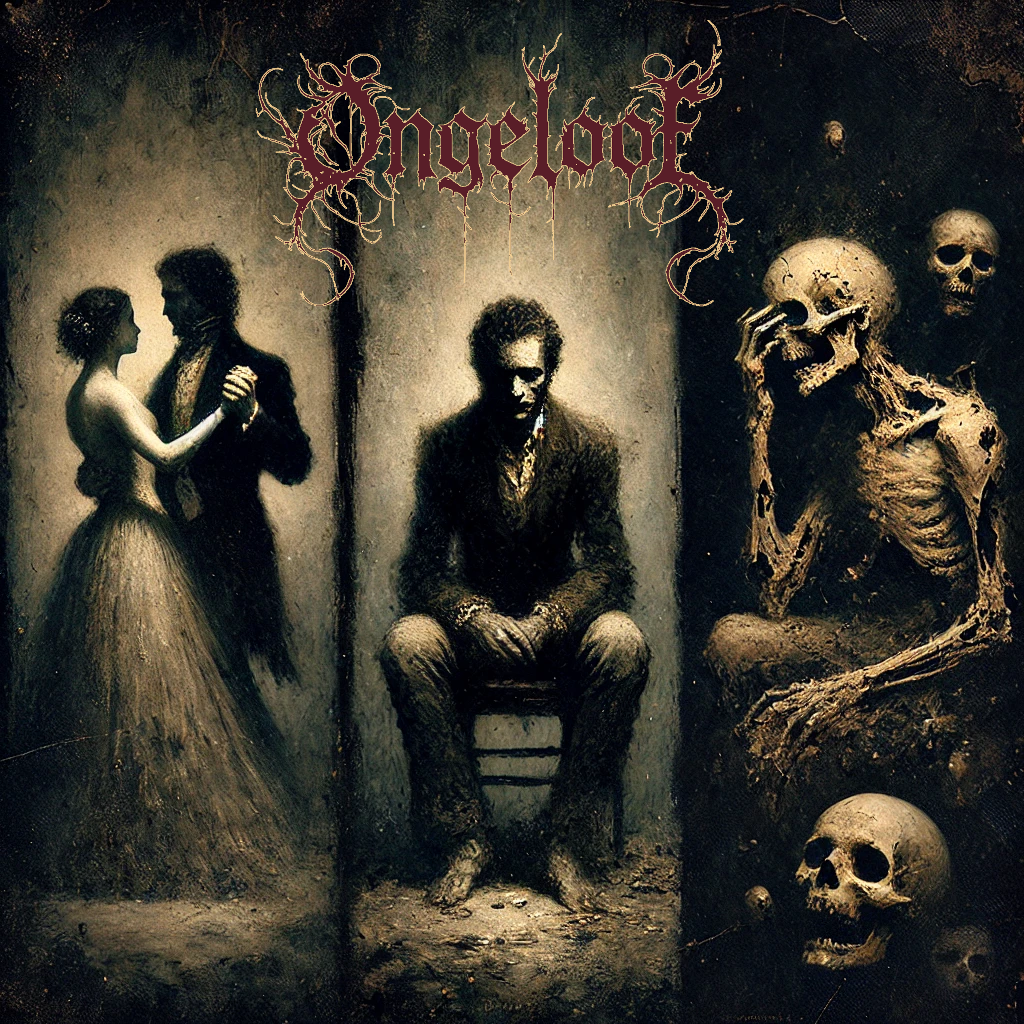
Capturing the essence of this song in a single artwork was a challenge. The layered themes of regret and the weight of time resisted confinement to a single depiction, as no single image felt like it captured the song's entire essence. The idea of using a triptych emerged and quickly offered the ability to explore multiple layers while presenting a sense of progression—offering depth in symbolism, while broadening the narrative.
In the central panel, a figure sits in silent contemplation, filled with regret and lost in the memory of a dance from his past—a telling symbol of the source of his bitterness. To one side, the dance itself serves as a glimpse into that fleeting moment of beauty, while the other side depicts decay and darkness: the inevitable end.
In an alternate interpretation, the central figure embodies man's internal conflict, caught between the beauty and the darkness within—a struggle that resonates deeply with the unending cycle of regret and destruction that lies at the heart of the song.
- Closing Thought
For me, this song is a remnant of darker days, crafted into a step toward becoming a better version of myself. It serves as a dark reminder, yet it also shines a light of hope on the path I walk. As with all creations born from my inner struggles, it carries within it the hope that others who feel burdened by similar emotions might find strength and solace in its existence.